
Preventing Heat Discoloration on Stainless Steel | 6 Useful Grinding Tips
Preventing heat discoloration on stainless steel is one of the most important skills in professional metal fabrication.
Heat discoloration, also known as heat tint, is not just a cosmetic problem for stainless steel parts.
It directly damages the passive chromium oxide layer that protects stainless steel from rust and corrosion.
Once damaged, the metal will lose its long-term durability and become vulnerable to staining and oxidation.
304 and 316 stainless steel are widely used in industrial, food, medical, and decoration fields.
The thermal conductivity of these alloys is only about one-third that of carbon steel.
Heat builds up extremely fast during grinding, making overheating and discoloration very common.
Learning effective methods for preventing heat discoloration on stainless steel will greatly improve product quality.
Understanding Heat Tint: Technical Thresholds & Corrosion Risks
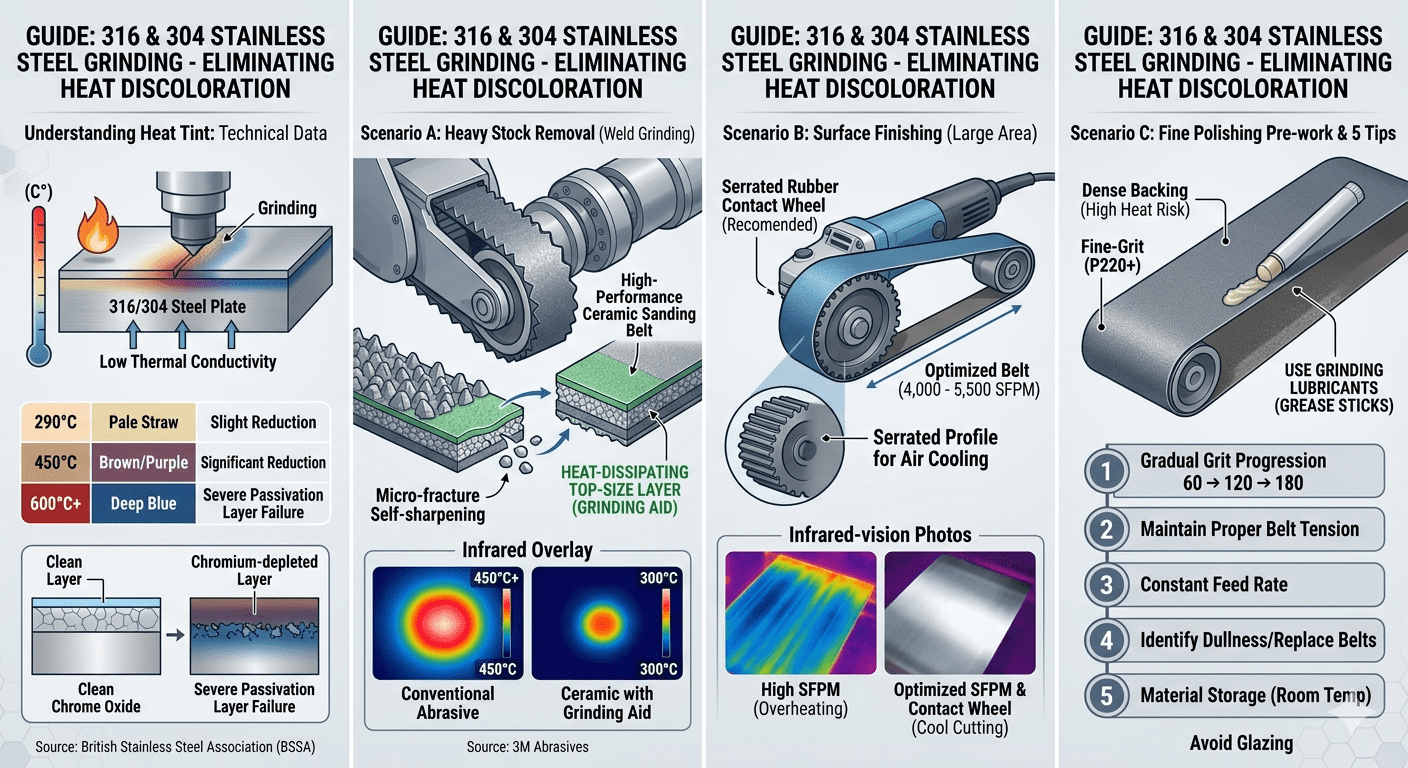
Heat discoloration happens when the surface oxide layer grows thicker under high grinding temperatures.
Different temperatures create different colors, and each color represents a different level of damage.
Even a light yellow tint means the corrosion resistance has already started to decline.
| Temperature (°C) | Surface Appearance | Impact on Corrosion Resistance |
|---|---|---|
| 290°C (554°F) | Pale Straw / Yellow | Slight Reduction |
| 450°C (842°F) | Brown / Purple | Significant Reduction |
| 600°C+ (1112°F+) | Deep Blue | Severe Passivation Layer Failure |
When temperature goes beyond 600°C, the protective layer fails completely.
At this point, no polishing or passivation can fully restore the original performance.
This makes preventing heat discoloration on stainless steel far more effective than fixing it later.
Thermal Control Solutions for Preventing Heat Discoloration on Stainless Steel
Scenario A: Heavy Weld Grinding & Stock Removal
Weld grinding requires high pressure and aggressive material removal.
These conditions create massive friction and lead to serious heat buildup.
Using low-quality belts will only make the problem worse by increasing heat.
- Use high-performance ceramic alumina sanding belts designed for stainless steel
- Self-sharpening ceramic grains stay sharp and reduce heat during cutting
- Belts with grinding aid coating lower temperature by up to 100°C for cool cutting
Scenario B: Surface Graining & Decorative Finishing
Large surface areas easily trap heat during finishing work.
Thin sheets are especially easy to turn blue or brown from overheating.
Controlling speed and contact tools is essential for preventing heat discoloration on stainless steel.
- Keep belt speed between 4,000 and 5,500 SFPM for stable and cool operation
- Use serrated rubber contact wheels to improve air flow and heat dissipation
- Avoid staying too long in one area to prevent local overheating
5 Essential Tips for Preventing Heat Discoloration on Stainless Steel
Follow these practical tips to completely avoid heat tint in daily production.
- Use gradual grit sequences such as 60→120→180 to reduce workload and heat
- Maintain proper belt tension to avoid slipping and unwanted friction heat
- Keep the tool moving at all times and never dwell on a single spot
- Replace glazed or dull belts immediately to avoid burning the surface
- Use grinding lubricants to reduce friction and control temperature efficiently
Refer to professional grinding technology from 3M Abrasives for better heat control solutions.
These methods are proven effective in factories around the world.
Combined with high-quality abrasives, they ensure consistent and clean results.
Final Recommendations
Preventing heat discoloration on stainless steel requires the right tools and correct operating habits.
Many workshops face high rework costs because they ignore heat management.
By using cool‑cutting ceramic belts and proper techniques, you can eliminate heat tint completely.
Your parts will maintain excellent appearance, corrosion resistance, and professional quality.
With consistent practice, preventing heat discoloration on stainless steel becomes fast and reliable.
Related Products:
Ceramic Sanding Belts for Stainless Steel | Cool Cutting Grinding Belts
By combining professional tools and correct operation, you can achieve perfect stainless steel finishing while preventing heat discoloration on stainless steel.