
Precision Grit Transition Guide: Achieving Mirror Finishes on Stainless Steel
Achieving a true #8 mirror finish on stainless steel (typically 304 or 316 grade) is not about the final buffing stage; it is won or lost during the grit transition. A single skipped step or a lingering scratch from a coarse sanding belt will become a glaring defect once the metal reaches a high-gloss state. To maintain industrial-grade [surface integrity], operators must follow a disciplined progression that manages the [Ra value] at every stage.
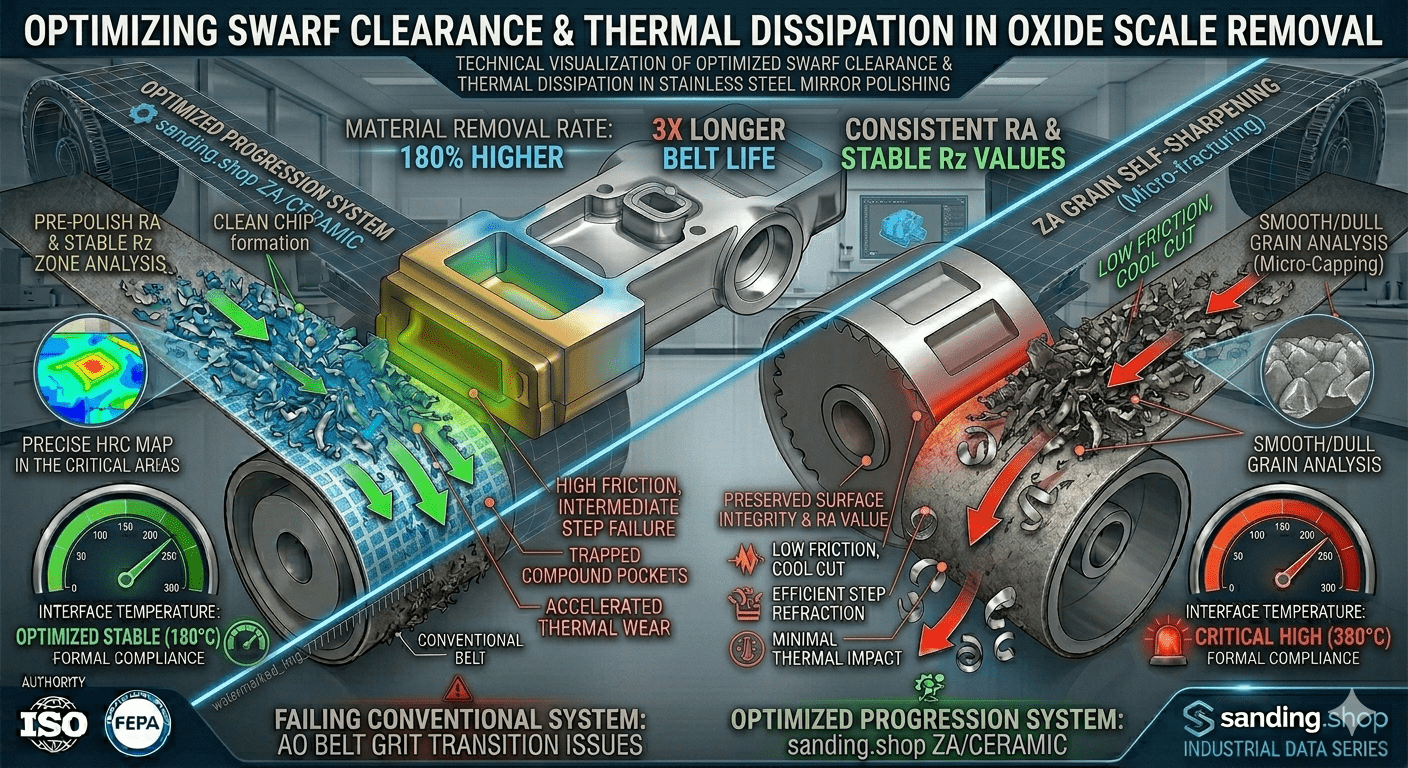 Infographic: sanding.shop Industrial Data Series – Visualization of Optimized Grit Transitions for Surface Preparation
The “Rule of 50%” in Grit Progression
A fundamental rule in high-precision polishing is never to more than double the grit number between steps. This ensures that the finer grains can effectively remove the “peaks” left by the previous coarser grains without leaving [swarf re-welding] zones.
- Stage 1: Heavy Leveling (Grit 80 – 120): Removes weld beads and deep mill scale. Focus on high [unit pressure].
- Stage 2: Intermediate Refinement (Grit 240 – 400): The most critical transition. This stage must eliminate all deep directional scratches.
- Stage 3: Pre-Polishing (Grit 600 – 1000): Using Ceramic Alumina or Trizact™ belts to create a satin-like finish with a stable [Ra value] below 0.2 µm.
- Stage 4: Final Preparation (Grit 2000+): A flexible cloth-backed belt or structured abrasive to prepare for the cotton buffing wheel.
Industry Performance Benchmarks
Data from the Specialty Steel Industry of North America (SSINA) suggests that a #8 finish requires a surface roughness (Ra) of less than 0.1 µm:
- Ra Reduction: Moving from 120 grit to 400 grit reduces surface roughness by approximately 75%.
- Thermal Impact: Optimized [swarf clearance] at 180°C prevents the “haze” caused by microscopic surface melting.
- Source: SSINA: Finishing of Stainless Steel Specifications
Scenario-Based Solutions
Scenario A: Polishing Large Sheets for Architectural Use
Challenge: Maintaining a perfectly uniform finish across a 4×8 foot 304 stainless sheet.
Solution: Use wide-belt sanders with a cross-hatch pattern transition. Move from 180 → 320 → 600 using sanding.shop ZA/Ceramic belts. The self-sharpening ZA grains ensure consistent [Ra maintenance] across the entire surface area.
Scenario B: Restoring Medical Equipment Finishes
Challenge: Removing scratches while maintaining strict geometric tolerances and preventing [grinding burn].
Solution: Implement a wet-grinding sequence with flexible J-weight belts. Progression: 240 → 400 → 800 → 1500. High-lubricity coolant maintains the interface at a stable 180°C to protect metallurgical integrity.
Technical FAQ: Mirror Polishing Mastery
1. Why do I see “clouds” or haze after buffing?
This is usually caused by skipping a grit step (e.g., jumping from 400 to 1000). The 1000 grit polishes the surface but leaves the 400 grit “valleys” intact, trapping buffing compound and creating a hazy appearance.
2. Should I change directions between grit steps?
Yes. Rotating the part 90 degrees (if possible) between steps allows you to visually confirm that the new, finer grit has completely removed the scratch pattern from the previous step.
3. Can I use Aluminum Oxide for the entire process?
While cheaper, AO grains dull quickly. For stainless steel, Zirconia Alumina (ZA) or Ceramic is more cost-effective for coarse steps as they stay sharp, preventing the heat that causes discoloration.
4. How do I know when to move to the next grit?
The surface should have a perfectly uniform scratch pattern. If you see any “errant” scratches that are deeper than the rest, you must continue with the current grit.
5. What is the role of [swarf clearance] in fine polishing?
If swarf (metal dust) is not cleared, it gets trapped between the belt and the part, causing “pigtail” scratches. Anti-loading coatings on sanding.shop belts are designed to eject debris efficiently.
Expert Finish Tip from sanding.shop
A mirror finish is only as good as the preparation. Our Mirror-Prep Series utilizes structured abrasive technology to bridge the gap between 400 grit and final buffing. Lower your [cost-per-part] by reducing buffing time by 40%. Explore our Polishing Abrasives Collection.