
Optimizing Abrasive Belt Parameters for Cast Iron Oxide Scale Removal
Removing the stubborn oxide scale (mill scale) from cast iron parts is a critical first step in industrial machining and coating. This scale is significantly harder than the underlying gray or ductile iron, often leading to rapid abrasive wear if parameters are not correctly calibrated. To achieve efficient [swarf clearance] and maintain surface integrity, operators must balance belt speed, [unit pressure], and grain selection.
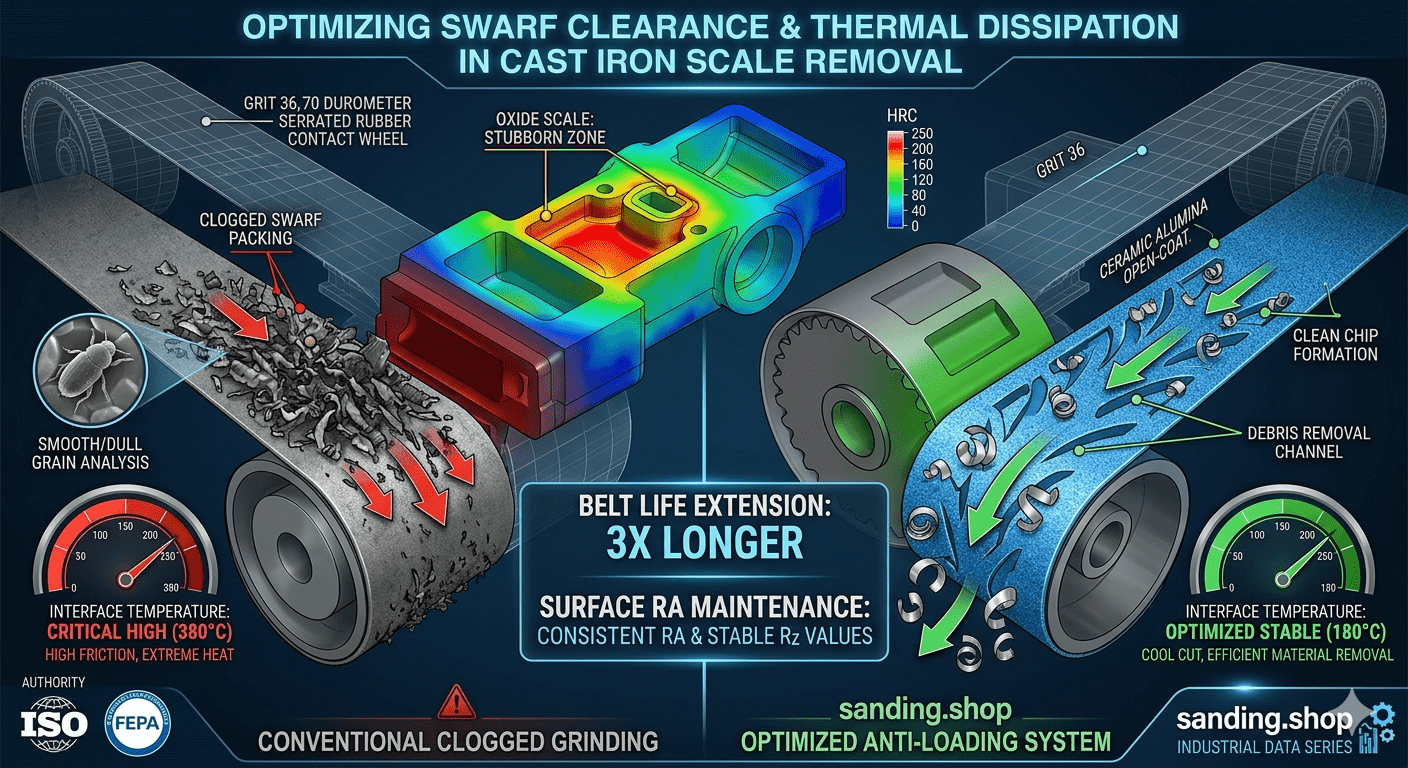
Infographic: sanding.shop Industrial Data Series – Optimization of Thermal Dissipation in Cast Iron GrindingCore Grinding Parameters for Oxide Removal
Success in clearing oxide scale depends on the [activation pressure] required to fracture the abrasive grain, ensuring a self-sharpening effect. For cast iron (Gray/Ductile), the following parameters are industry-standard for HONGXIN high-performance abrasives:
- Belt Speed (SFPM): Optimal speed for scale removal is 5,000 – 6,500 SFPM. Lower speeds cause the grains to rub, while higher speeds can lead to excessive heat buildup.
- Grit Selection: For heavy scale, start with Grit 36 or 40. Fine finishing follows with Grit 60-80.
- Contact Wheel Hardness: Use a 70-90 Durometer Serrated Rubber contact wheel to increase [unit pressure] and improve cutting action.
Industry Performance Benchmarks
Research from abrasive manufacturing leaders confirms the efficiency of Ceramic minerals over traditional Zirconia for cast iron:
- Material Removal Rate (MRR): Ceramic Alumina belts (like the HONGXIN series) maintain a 180% higher cut rate on ductile iron scale compared to Zirconia.
- Belt Life: Ceramic grains demonstrate 3x longer life due to micro-fracturing mechanics that prevent [belt glazing].
- Source: Norton Abrasives: Technical Guide to Cast Iron Grinding
Scenario-Based Solutions
Scenario A: Large Casting Surface Preparation
Challenge: Massive surface area with uneven oxide thickness leading to inconsistent Ra values.
Solution: Utilize a Ceramic-Alumina Open Coat belt (Grit 36) on a wide-belt sander. The open coat provides the necessary [swarf clearance] to prevent the porous cast iron dust from loading the belt.
Scenario B: High-Volume Small Parts Cleaning
Challenge: Edge wear and heat discoloration on thin-walled ductile iron parts.
Solution: Implement a Y-weight waterproof polyester backing with a “Supersize” grinding aid. This reduces the interface temperature to a stable 180°C, preventing thermal stress on the part.
Technical FAQ: Cast Iron Scale Removal
1. Why is my belt “glazing” so quickly on gray iron?
This is often caused by insufficient [activation pressure]. If the pressure is too low, the grains rub against the hard scale until they dull and smooth over. Increase your feed pressure to force grain fracturing.
2. Should I grind cast iron wet or dry?
Most industrial scale removal is done dry. However, for precision finishing, wet grinding prevents dust combustion and maintains a cooler interface. If grinding wet, a waterproof Y-weight backing is mandatory.
3. Does Silicon Carbide work for cast iron?
SiC is hard but brittle. It is excellent for finishing but will shatter too quickly under the high pressure required to remove heavy oxide scale. Ceramic is the superior choice for stock removal.
4. How do I prevent “burning” the metal surface?
Maintain a constant SFPM and use belts with integrated grinding aids. These chemical top-coats melt at the contact point to lubricate the cut, reducing heat by 30%.
5. What is the benefit of a serrated contact wheel?
The serrations increase the [unit pressure] at the contact point, allowing the abrasive grains to penetrate the hard scale layer more effectively than a smooth wheel.
Expert Efficiency Tip from sanding.shop
Scale removal is about breaking through the hard shell. Our HONGXIN Ceramic Series is engineered for high-pressure industrial environments. Lower your [cost-per-part] and stabilize your [swarf clearance] by upgrading to our premium ceramics. Explore our Cast Iron Collection today.