
Global Abrasive Standards: Essential FEPA, CAMI, and JIS Grit Sizes Guide
In high-precision manufacturing and fine woodworking, switching between abrasives from different regions can result in unexpected finish variations. Mastering global abrasive standards is the first step to consistent results.
A sanding belt labeled “P400” in Europe does not yield the same surface roughness as a “400-grit” belt in the United States.
Navigating the differences between FEPA, CAMI, and JIS is essential when tight tolerances are required. These three systems form the foundation of global abrasive standards for industrial use.
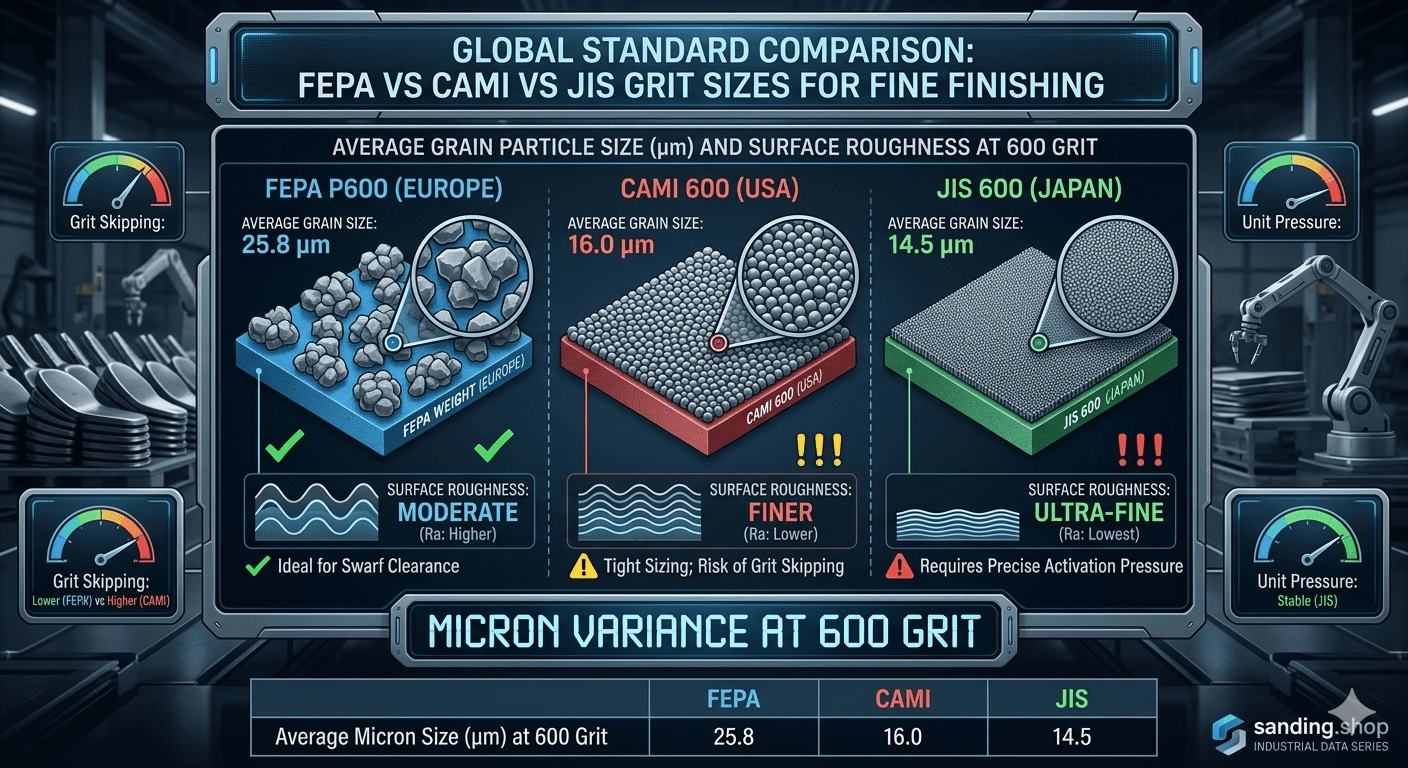
Understanding the mathematical conversion and how each standard calculates grit size is critical to maintaining a consistent [cost-per-part] and ensuring that [activation pressure] results in the desired surface roughness (Ra). Correctly applying global abrasive standards prevents costly finishing errors.
Global Abrasive Standards: FEPA “P”, CAMI, and JIS Grit Systems
The core difference between the systems lies in their sizing philosophy. While CAMI measures the average particle size with a tighter distribution on fine grits, FEPA (the “P” grade) defines a wider but strictly controlled range of particle sizes for industrial use.
- 1. CAMI (USA): Uses a straightforward grading system where the grit number directly corresponds to the mesh size of the screen used to sift the particles. In the 240+ range, CAMI grits are often slightly finer than their FEPA counterparts, resulting in a higher [unit pressure] concentration if not managed correctly.
- 2. FEPA “P” Grade (Europe): The FEPA P-scale is highly standardized for coated abrasives. For instance, a P400 and a P800 are designed to leave a precise Ra (Roughness Average) on steel and hard woods.
- 3. JIS (Japan): The JIS standard mirrors FEPA in many high-grit categories but relies on a different testing sieve methodology, often leading to slightly more uniform particle sizes in the micro-grit range.
Industry Technical Data Reference
Data compiled by the UAMA and FEPA testing quantify the average particle size across global abrasive standards for fine grits:
- Comparison at 240 Grit: CAMI 240 features an average particle size of 52 µm, while FEPA P240 averages 52.2 µm—making them highly interchangeable.
- Comparison at 600 Grit: CAMI 600 averages 16.0 µm, FEPA P600 averages 25.8 µm, and JIS 600 averages 14.5 µm. This reveals a significant divergence where a P600 belt will leave a rougher finish than a JIS 600 belt.
- Data Source: FEPA: Coated Abrasives Standards
Scenario-Based Solutions: Standardizing Your Abrasive Selection
Scenario A: Calibrating Robotic Fine Finishing of Aerospace Titanium
The Challenge: Your robotic grinding cell switches from US-made CAMI 600 belts to European FEPA P600 belts, and the surface finish fails the post-processing inspection.
Actionable Fix:
- 1. Recalibrate the Sequence. Because FEPA P600 is significantly coarser (25.8 µm) than CAMI 600 (16.0 µm), adjust your sequence to include an intermediate step, such as using P800 or a high-grit flexible [J-weight vs. F-weight] backing.
- 2. Adjust the SFPM. Lower your [SFPM] by 10% to account for the larger grain size, preventing deep [grinding burn].
Scenario B: Manual Micro-Finishing on Carbon Steel Clubheads
The Challenge: A shop operator is achieving a “cloudy” finish when transitioning between Japanese JIS and European abrasive standards on multi-contour surfaces.
Actionable Fix:
- 1. Use the Cross-Reference Matrix. Always verify the micrometer (µm) size rather than the grit number. Use a [crepe rubber] stick to keep belts clean and ensure the finish remains uniform.
Technical FAQ: International Abrasive Standards
Q1: Why does a P400 belt feel more aggressive than a CAMI 400 belt?
A: In the higher grit ranges, the particle size distribution differs. A FEPA P400 grain can vary more in size to aid in swarf removal, whereas CAMI 400 grains are more tightly controlled for fine wood and metal polishing.
Q2: Will switching between standards cause [grit skipping]?
A: Yes, if you blindly follow the printed number without checking the actual micrometer (µm) size. Jumping from a fine CAMI 600 to a FEPA P400 will cause visible scratch variations. Always use an intermediate step when changing standards.
Q3: How does standard variance affect [activation pressure]?
A: The size of the abrasive particles dictates how much force is required to self-sharpen the grain. Using larger FEPA P-grade grains under the same force on a hard backing will result in a higher [unit pressure], potentially cutting deeper into the substrate.
Formal Industry References & Compliance
This technical guide follows established global abrasive standards from FEPA, ANSI, and UAMA.
- FEPA: Coated Abrasives Grain Size Limits (Standard 43-1). fepa-abrasives.org
- ANSI B7.7: Coated Abrasive Products – Grading and Evaluation.
At sanding.shop, we provide clear micrometer cross-references for all our products.
Explore our Global-Standard Abrasive Series and talk to an expert today.