
Abrasive Belt Storage: Why Your Warehouse Needs Dehumidification for Paper-Backed Belts
In the industrial abrasives sector, the quality of a sanding belt is heavily dependent on its storage conditions. Proper abrasive belt storage is often overlooked but critical to preserving product performance.
For paper-backed sanding belts, humidity is the most critical environmental factor. High ambient humidity does not just degrade the abrasive; it causes uneven moisture absorption, leading to severe curling, edge-fraying, and dimensional instability.
Without strict humidity control, your stock can become unusable before it even reaches the machine. Understanding the basics of abrasive belt storage can prevent costly waste.
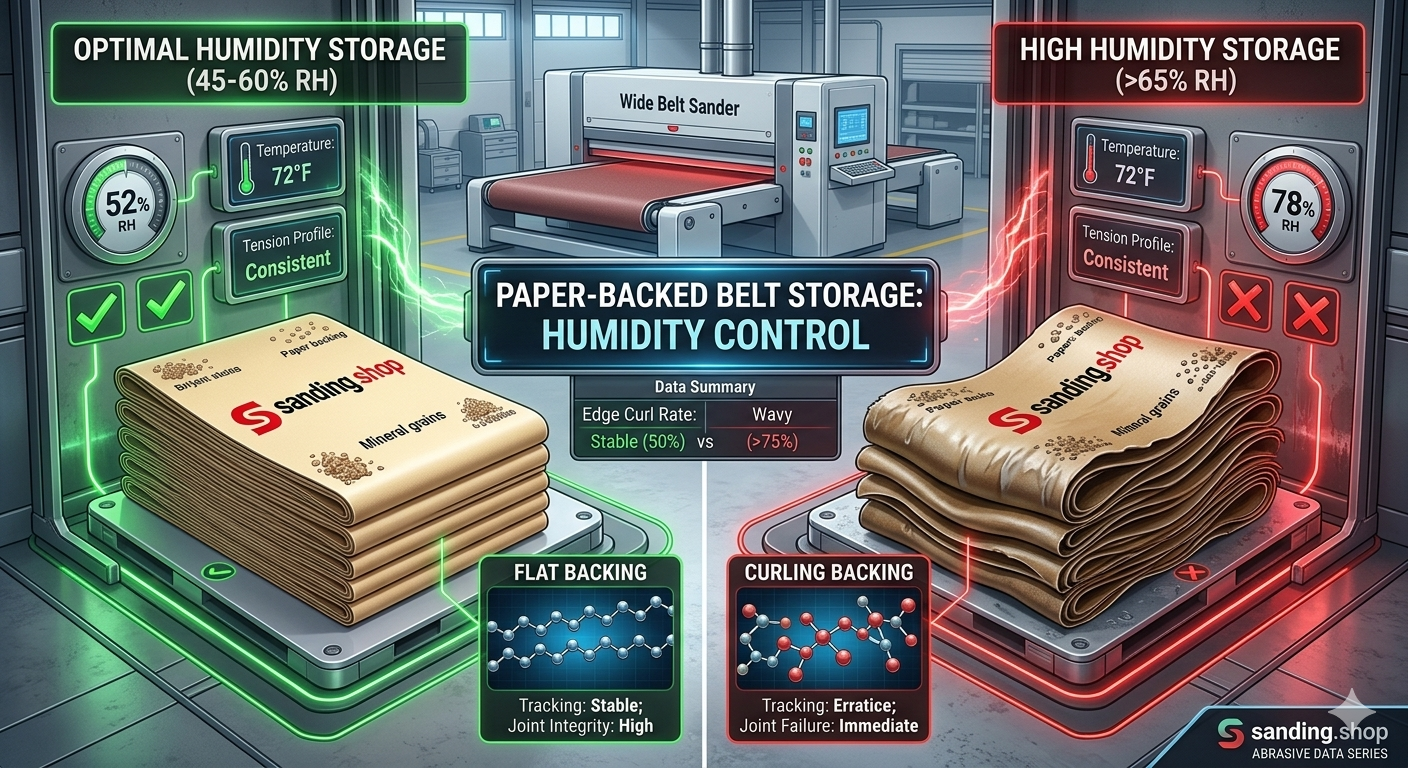
Understanding the physics behind paper fiber expansion and how it leads to curling and warping is essential for minimizing waste and ensuring a consistent cost-per-part during production.
This is the foundation of effective abrasive belt storage in industrial environments.
Abrasive Belt Storage: The Science of Curling and Warping
Paper-backed abrasives consist of multiple layers: the paper base, adhesive resins, and mineral grains. The paper component is hygroscopic, meaning it absorbs and releases moisture relative to the surrounding air:
- 1. Moisture Imbalance: When the storage facility’s relative humidity (RH) exceeds 65%, the paper backing absorbs moisture and expands at a faster rate than the resin and abrasive layers. This creates internal mechanical stress, forcing the edges of the belt to curl upward (wavy edges).
- 2. Premature Joint Failure: A curled or buckled belt cannot track properly on the contact wheel. When placed under high tension, the joint area experiences stress concentration, leading to premature snapping or joint separation.
- 3. [Abrasive Aging] and Brittleness: Excess moisture softens the resin bond, while rapid drying makes the paper brittle, causing premature shedding of the grains during use.
Industry Technical Data Reference
Data compiled by the UAMA (Unified Abrasives Manufacturers Association) and technical testing from Klingspor Abrasives quantify the optimal storage parameters for abrasive belt storage:
- Optimal Relative Humidity (RH): Coated abrasives should be stored between 45% and 60% RH at a temperature of 15°C to 24°C (59°F to 75°F).
- Dimensional Change: A paper belt exposed to 75% RH for 48 hours can expand by up to 2.5% across its width, rendering it useless for precise calibration work.
- Data Source: Klingspor Abrasives: Technical Guide on Storage and Handling of Coated Abrasives
Scenario-Based Solutions: Warehouse Dehumidification Protocols
Scenario A: Managing High Humidity in Coastal Manufacturing Facilities
The Challenge: Your warehouse experiences 80% humidity during the summer, causing paper belts to curl inside their boxes before use.
Actionable Fix:
- 1. Install Commercial Dehumidifiers. Maintain the warehouse RH below 60%. Use digital hygrometers to log humidity data and prevent the paper fibers from absorbing excess moisture.
- 2. Proper Packaging Rotation. Keep the belts in their original factory-sealed polyethylene wrapping until the day they are mounted on the machine.
Scenario B: Restoring Slightly Curled Belts
The Challenge: A batch of paper-backed belts shows slight edge-curling, leading to tracking issues on the [sanding belt direction] sensors.
Actionable Fix:
- 1. Climate Conditioning Cabinet. Place the belts in a climate-controlled rack at 50% RH for 24 hours to allow the paper fibers to relax and the belt to flatten.
- 2. Check Tension Settings. Lower the initial tension slightly to allow the belt to settle onto the contact wheel before applying full power.
Technical FAQ: Abrasive Storage and Curling Control
Q1: Why do my paper-backed belts curl on the edges while the center stays flat?
A: The edges of the belt are exposed to the ambient air, allowing them to absorb moisture faster than the center. This differential expansion rate causes “wavy edges,” which is a classic indicator of high humidity storage environments without proper [dehumidification] and abrasive belt storage controls.
Q2: Can I use a heated dry box to store paper sanding belts?
A: Yes, but with caution. Lowering the humidity too much (below 35% RH) makes the paper backing brittle and prone to snapping. A dehumidifier that maintains a balanced RH is much safer than relying purely on heat.
Q3: How does the paper backing’s moisture content affect [activation pressure] during grinding?
A: When paper absorbs moisture, the backing becomes softer and more compliant, acting similarly to a 60 Shore A contact wheel. It loses the rigidity needed to apply high force, resulting in a lower material removal rate and poor surface flatness.
Formal Industry References & Compliance
This technical guide follows established global abrasive standards for safe and effective abrasive belt storage:
- FEPA: Safety and storage recommendations for coated abrasives. fepa-abrasives.org
- ANSI B7.7: Safety requirements for the use, care, and protection of abrasive wheels and belts.
At sanding.shop, we design our paper backings with moisture-resistant resins to minimize curling, but environmental control remains key to maximizing your total [cost-per-part].
Explore our Precision Abrasive Portfolio and talk to an expert today.