
High-Performance Grinding: Special Abrasive Belt Selection for Nickel-Based Superalloys (Inconel)
Inconel abrasive belt selection is the most critical step for high-performance nickel superalloy grinding, directly impacting part quality, belt life, and production efficiency.
Nickel-based superalloys, such as Inconel 625 and 718, are the backbone of the aerospace and power generation industries due to their incredible strength at high temperatures. However, these same properties make them a “nightmare” for standard abrasives. Inconel work-hardens rapidly and has extremely low thermal conductivity, meaning heat stays at the grinding interface, leading to [grinding burn] and immediate [belt glazing]. To maintain a profitable [cost-per-part], specialized belt technology is mandatory, and proper inconel abrasive belt selection is the foundation of success.
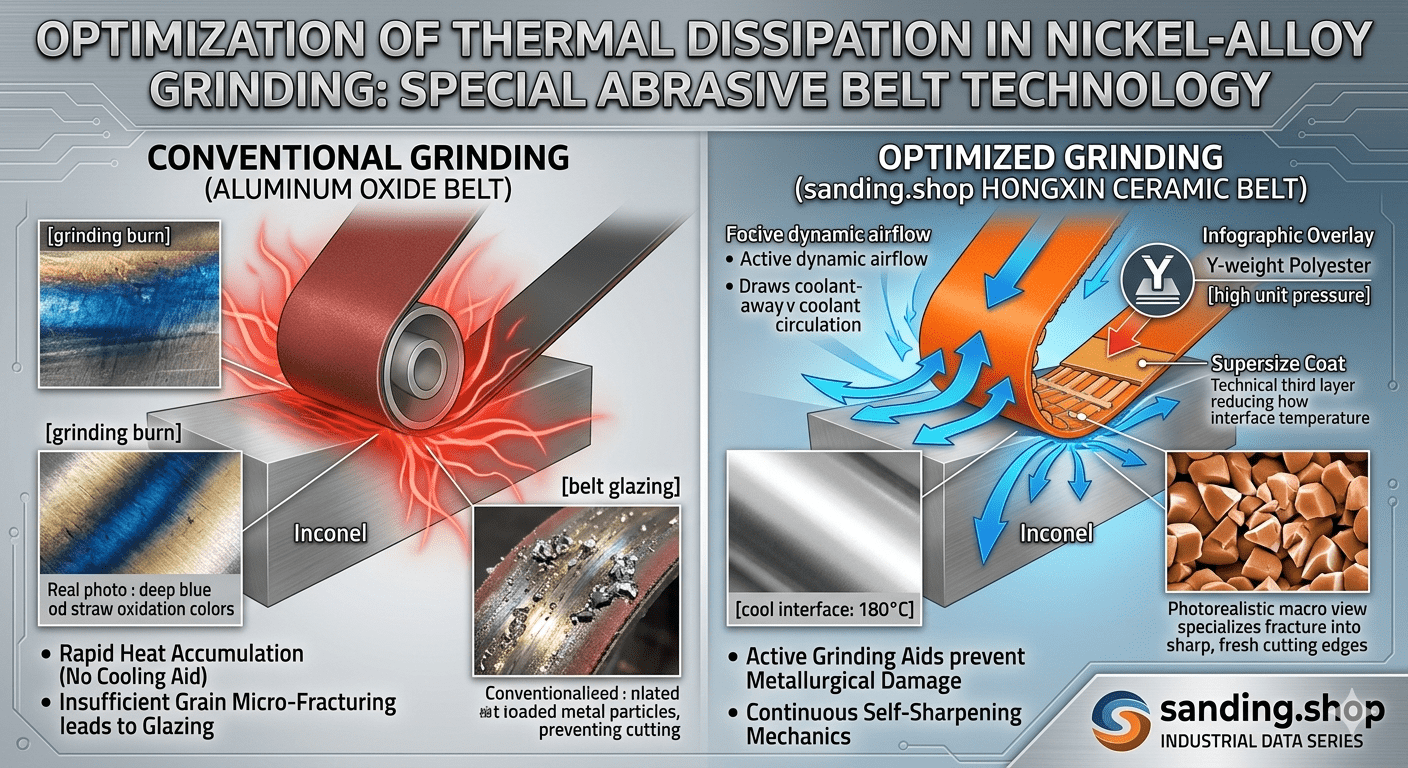
Infographic: sanding.shop Industrial Data Series – Optimization of Thermal Dissipation in Nickel-Alloy Grinding
Inconel Abrasive Belt Selection: Why Premium Ceramics are Mandatory
Grinding Inconel requires an abrasive that can “micro-fracture” under extreme heat and pressure, a non-negotiable requirement for effective inconel abrasive belt selection. Standard Aluminum Oxide or Zirconia grains will simply round over, creating friction instead of cutting. According to industry technical data, Ceramic Alumina is the only viable mineral for high-removal Inconel processing.
- Micro-Fracturing Mechanics: Specialized ceramic grains break down into tiny, razor-sharp fragments, ensuring the belt never loses its “bite” even on work-hardened surfaces.
- Supersize Grinding Aids: A technical “Third Layer” coating acts as a solid lubricant, reducing the interface temperature by up to 150°C to prevent metallurgical damage.
- Heavy-Duty Backing: For the high [unit pressure] required, a stiff Y-weight or YY-weight Polyester backing is essential to prevent belt stretching.
Inconel Abrasive Belt Selection: Industry Performance Benchmarks
Data from global abrasive leaders like 3M and Saint-Gobain validates the Ceramic advantage on Inconel 718, a key factor in proper inconel abrasive belt selection:
- Cut Rate: Precision-shaped ceramic grains provide a 200% higher removal rate compared to standard crushed ceramic.
- Belt Longevity: Belts with active grinding aids (like the sanding.shop HONGXIN series) last 3x to 4x longer in dry grinding applications.
- Source: 3M Cubitron™ II Performance Data
Scenario-Based Inconel Abrasive Belt Selection Solutions
Scenario A: Turbine Blade Casting Flash Removal
Challenge: Extremely high [unit pressure] required to remove heavy flash from Inconel 718 castings without causing cracks, a common pain point in inconel abrasive belt selection.Solution: Use a Grit 36 Ceramic Alumina belt with a 90 Durometer Serrated Contact Wheel. Maintain a belt speed of 4,500 – 5,500 SFPM. The high pressure ensures the grain fractures correctly, while the serrations provide [swarf clearance].
Scenario B: Aerospace Structural Component Finishing
Challenge: Achieving a specific Ra finish on thin-walled Inconel parts without inducing thermal stress, which heavily depends on the right inconel abrasive belt selection.Solution: Transition to a Grit 80 or 120 Ceramic belt with a high-lubricity “Supersize” coat. Lower the [SFPM] to 3,500 to minimize heat generation while the grinding aid maintains a cool interface temperature of 180°C.
Technical FAQ: Inconel Abrasive Belt Selection Secrets
1. Why does my belt “glaze” (turn shiny) almost immediately?
This is caused by insufficient [activation pressure]. Inconel is so hard that if you don’t push hard enough, the grain doesn’t fracture—it just rubs and melts the metal onto the belt surface, even with good inconel abrasive belt selection.
2. Is wet grinding better than dry for Inconel?
Wet grinding with high-quality coolant is superior for belt life and part integrity. However, if dry grinding is necessary, you must use a belt with a “Supersize” grinding aid to manage the heat, which is part of a complete inconel abrasive belt selection strategy.
3. Can I use Zirconia belts for Inconel?
Zirconia is acceptable for light-duty cleaning, but for stock removal, it is inefficient. Ceramic belts will provide a significantly lower [cost-per-part] due to their self-sharpening ability, making them the top choice in inconel abrasive belt selection.
4. What is the biggest mistake in Inconel grinding?
Running the belt at too high a speed. Excessive [SFPM] creates “flash heat” that work-hardens the Inconel before the grain can even cut it, negating the benefits of good inconel abrasive belt selection.
5. How do I identify “Grinding Burn” on Inconel?
Look for a straw or blue discoloration. Even if invisible, excessive heat can create a “White Layer” that is prone to fatigue cracking; specialized coatings from sanding.shop are designed to prevent this, paired with proper inconel abrasive belt selection.
Expert Optimization Tip from sanding.shop
Grinding Inconel is a game of heat management, and inconel abrasive belt selection is your most powerful tool. At sanding.shop, we offer High-Activation Ceramic Series specifically engineered for aerospace superalloys. Stabilize your [swarf clearance] and lower your production costs today.