
Proven Titanium Machining: The Critical Synergy Between Coolant and Abrasive Belts
Titanium Machining relies on balanced fluid-abrasive matching to overcome inherent material drawbacks. Titanium alloys, particularly Ti-6Al-4V, are notoriously difficult to finish due to their low thermal conductivity and high chemical reactivity at elevated temperatures. During grinding, heat does not dissipate into the workpiece but remains at the contact point, leading to catastrophic [grinding burn] and rapid [belt glazing]. To achieve aerospace-grade surface integrity, manufacturers must synchronize the chemical properties of their coolant with the mechanical structure of their sanding belts for stable titanium machining output.
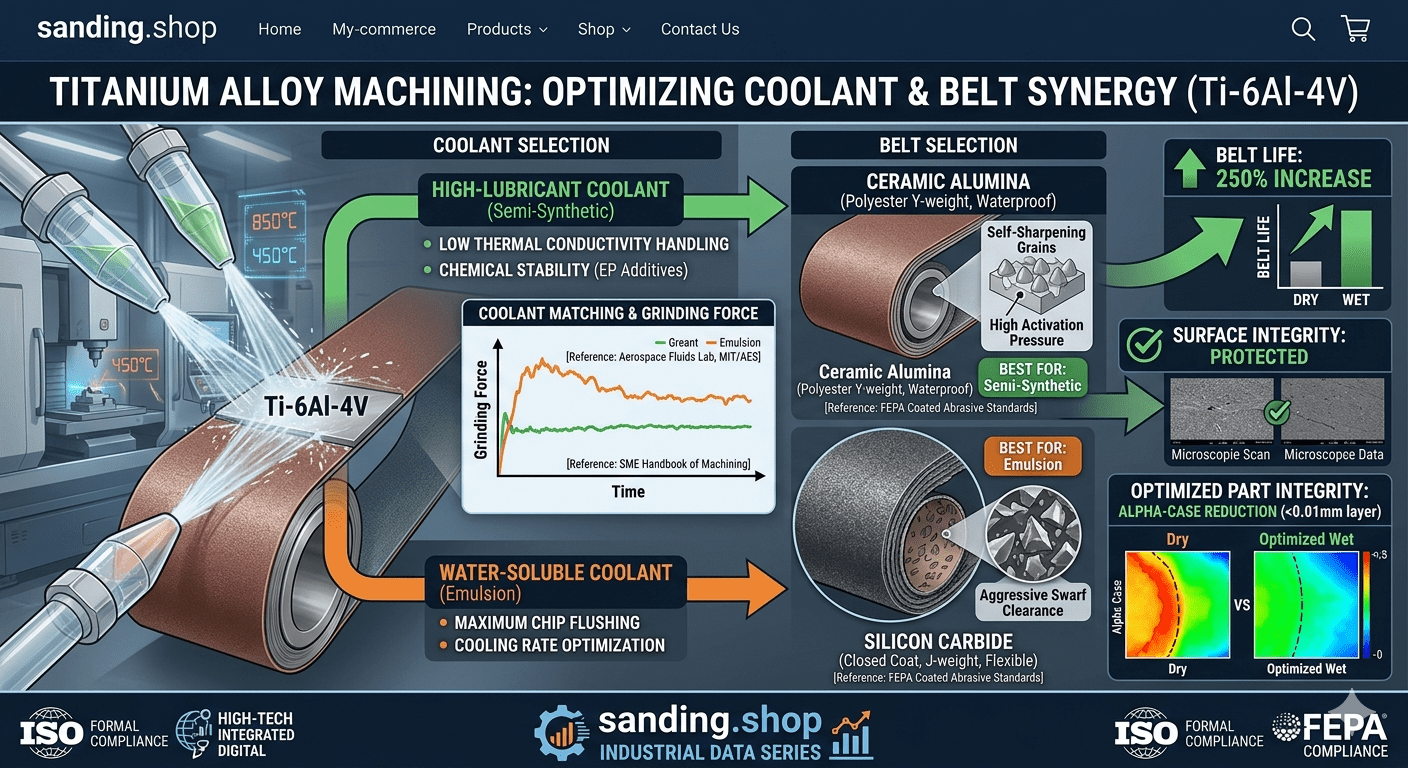
Infographic: sanding.shop Industrial Data Series – Optimizing Coolant & Belt Synergy for Ti-6Al-4V
Titanium Machining Technical Conflict: Adhesion vs. Dissipation
Titanium is “sticky.” At grinding temperatures exceeding 500°C, titanium micro-chips tend to weld themselves to the abrasive grains—a phenomenon known as “capping.” Without the correct coolant film, even the most expensive Ceramic Alumina belt will fail within minutes and ruin your planned titanium machining workflow.
- The Alpha-Case Risk: Excessive heat during dry or poorly lubricated grinding creates a brittle oxygen-enriched surface layer called the “Alpha-case,” which severely compromises the fatigue life of aerospace components.
- Chemical Lubricity: Specialized coolants use Extreme Pressure (EP) additives (Esters or Chlorinated compounds) to create a low-shear chemical barrier.
- Water-Proof Backings: For wet grinding, belts must utilize Y-weight Polyester backings to prevent stretching and tracking issues.
Titanium Machining Industry Performance Benchmarks
According to research from the Aerospace Fluids Lab and SME Handbook of Machining, matching fluid chemistry to mineral type yields measurable ROI for reliable titanium machining:
- Belt Life Extension: Optimized semi-synthetic coolants can increase the life of a Ceramic belt by up to 250% compared to dry grinding.
- Surface Temperature: Flood cooling with high-lubricity emulsions maintains interface temperatures below 350°C, ensuring the Alpha-case layer remains under 0.01mm.
Scenario-Based Titanium Machining Solutions
Scenario A: High-Removal Robotic Grinding of Turbine Blades
Challenge: Massive stock removal requires high [unit pressure], leading to rapid belt wear during high-volume titanium machining.
Solution: Use sanding.shop Ceramic-Max belts (Y-weight) paired with a 10-12% concentration of semi-synthetic coolant. The high oil content provides the lubricity needed for “cool cutting,” while the ceramic grain ensures the [activation pressure] is met without burning the part.
Scenario B: Precision Finishing of Medical Implants (Ti-Gr5)
Challenge: Achieving an ultra-smooth Ra value while maintaining strict geometric tolerances for medical-grade titanium machining.
Solution: Utilize flexible Silicon Carbide (J-weight) belts with a fine-mist synthetic coolant. Silicon carbide’s sharp, brittle nature allows for clean micro-shearing at lower pressures, while the mist prevents [Static Buildup] and chip re-welding.
Technical FAQ: Titanium Machining & Coolant Strategy
1. Why shouldn’t I use standard water-soluble oil for Titanium?
Standard oils often lack the thermal stability and EP additives required to prevent titanium from welding to the belt. This results in instant [belt glazing] and costly downtime for your titanium machining setup.
2. Can I use straight oil for grinding Titanium?
While straight oil provides superior lubrication, it poses a significant fire risk due to titanium’s pyrophoric nature. High-water semi-synthetics are the safer industrial standard.
3. What is the best belt speed (SFPM) for wet Titanium grinding?
In wet environments, maintain 2,500–3,500 SFPM. Going higher increases the risk of the coolant being “thrown off” the belt by centrifugal force before it reaches the cut zone.
4. How do I know if I have Alpha-case damage?
Visually, a yellowish or bluish tint indicates oxidation. However, Alpha-case is often invisible and requires metallographic etching or nital etching for detection.
5. Does the pH of the coolant affect the sanding belt?
Yes. Highly alkaline coolants (pH > 9.5) can degrade the resin bond of the belt over time. Aim for a stable pH of 8.5 to 9.2 for maximum belt integrity during daily titanium machining runs.
Expert Optimization Tip
Precision titanium finishing is about controlling the thermal-chemical interface. At sanding.shop, we offer waterproof Ceramic and SiC series specifically calibrated for aerospace coolants to streamline your titanium machining workflow. Lower your [cost-per-part] by optimizing your fluid-belt synergy today.