
In this comprehensive guide, we dive deep into the physics of belt joint chatter and provide actionable solutions to restore your surface finish. Read on to learn how to eliminate periodic sanding marks once and for all
Deep Analysis: How to Completely Eliminate Sanding Marks Caused by Belt Joint Chatter
In high-end scenarios such as stainless steel polishing and titanium alloy precision machining, many operators encounter a tricky problem: periodic cross-grain chatter marks with uniform spacing on the workpiece surface, and even hard-to-eliminate “shadow marks” after high-gloss finishing — this is known as sanding belt joint chatter. Based on customer case statistics from sanding.shop, even when using imported ceramic abrasive belts, if the joint process does not match the working conditions, the yield rate will still drop by 15%-22%, especially for precision workpieces with Ra ≤ 0.8μm.
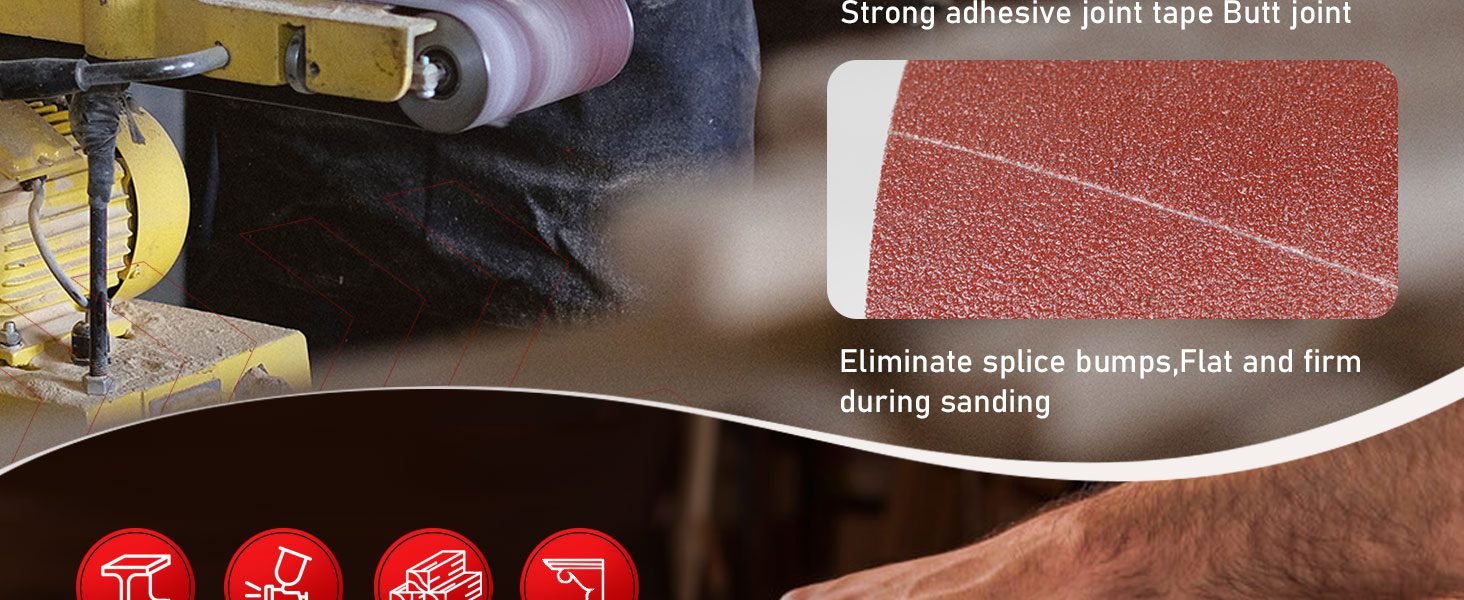
I. The Physics Behind the Issue
The core cause of joint chatter is the “tiny difference” between the thickness of the sanding belt joint and the base material. Our laboratory tests at sanding.shop have found that when the belt linear speed reaches 3000 SFPM, even a thickness difference of 0.01mm will generate instantaneous centrifugal force on the surface of the contact wheel, causing slight deviation of the grinding head and ultimately leaving periodic chatter marks on the workpiece surface. This pressure imbalance is more obvious on ceramic sanding belts with thick base materials (such as Y-Weight cloth base), which is also the core reason why many customers feedback that “high-priced sanding belts still have chatter.”
Industry Data Reference (UAMA)
According to technical standards from the United Abrasives Manufacturers Association (UAMA) and ANSI B74.18:
-
Thickness Tolerance: The thickness of the reinforcing tape for high-quality butt joints should be controlled within 5%–8% of the base belt thickness. If the joint thickness exceeds 10% of the total base belt thickness at 3000 SFPM, the instantaneous impact force is sufficient to leave visible micron-level marks on stainless steel.
-
Source: UAMA Technical Standards for Coated Abrasives (Refer to ANSI B74.18)
II. Scenario-Based Solutions
Scenario A: Periodic Shadows in Metal Polishing
Cause: Uneven abrasive distribution or excessive overlap at the joint.
Solutions:
-
Replace Joint Type: Prioritize the “double-layer reinforced butt joint” customized by sanding.shop. The thickness of its reinforcing tape is strictly controlled within 5%-7% of the base material thickness (lower than the industry standard of 10%), avoiding impact force caused by joint protrusion; abandon traditional lap joints, especially not suitable for stainless steel polishing scenarios with high Ra requirements.
-
Adjust Contact Wheel Hardness: Match a soft rubber contact wheel with Shore A 50–60 hardness, and it is recommended to use our sanding belt tension adjustment tool to avoid amplifying joint rigidity due to excessive tension — this is practical experience summarized by us serving more than 100 precision machining customers.
-
Opposite Rotation: Check the sanding belt running direction. For sanding belts with arrow indicators, the direction must be strictly followed to prevent edge peeling at the lap joint.
Scenario B: Chatter in Wide-Belt Sanders
Cause: Warping of the base material at the joint due to environmental humidity.
Solutions:
-
Environmental Control: Maintain shop humidity between 45%–55%. According to experiments by 3M Abrasives Systems, fluctuations in substrate moisture content can cause 2-3 mil deformation in joint thickness.
-
Pre-stretching: The sanding belt should be idled on the machine for 5-10 minutes before use to balance the joint to working temperature and flexibility; for thick base material sanding belts customized by sanding.shop, it is recommended to extend the pre-stretching time to 10-15 minutes for more stable results.
III. Frequently Asked Questions (FAQ)
Q1: Why do my expensive ceramic belts still chatter during high-gloss stainless steel polishing?
A: This is one of the most frequently asked questions by our sanding.shop customers. Ceramic sanding belts mostly use thick Y-Weight cloth base. The thicker the base material, the more prominent the mechanical difference between the joint reinforcing tape and the base material. Especially in high-gloss polishing scenarios, tiny chatter will be amplified. Two-step operation is recommended: ① Reduce the air pressure tension by 10% to avoid excessive rigidity; ② Match our customized “joint buffer layer sanding belt” to further reduce 80% of joint chatter marks.
Q2: Does joint chatter mean the belt is defective?
A: Not necessarily. Joint chatter may also result from contact wheel damage (such as grooves or out-of-roundness on the surface). The inspection method summarized by our technical team at sanding.shop: Remove the sanding belt and measure the radial runout of the contact wheel with a micrometer. If it exceeds 0.05mm, the problem is not with the sanding belt, and you can contact us for contact wheel calibration suggestions.
Q3: Are angled joints better than straight joints?
A: Yes. Angled joints at 55° or 67° can significantly reduce chatter. Because the angled joint gradually enters the grinding zone, instead of being stressed at the same moment like a straight joint, thereby dispersing the shock wave. For precision machining scenarios, sanding.shop can provide customized angle beveled joints to adapt to different models of sanders.
IV. References & Technical Support
Sources:
-
1. Coated Abrasives Fabricators Association (CAFA) – Joint Integrity Standards (cafa-info.org)
-
2. 3M Industrial Abrasives & Finishing Division – Technical Bulletin on Belt Chatter
-
3. Norton Abrasives (Saint-Gobain) – Troubleshooting Guide: Sanding Marks
-
4. sanding.shop Laboratory Test Report (2026) — “Correlation Analysis Between Ceramic Sanding Belt Joint Chatter and Workpiece Surface Roughness”
Professional Tip: If your process has extremely high requirements for surface roughness (Ra value), welcome to visit sanding.shop to consult our technical team and obtain customized ultra-smooth joint solutions for stainless steel and titanium alloy.